
How They See You — According to Your Wardrobe
- OMi Wolf
- Feb 17, 2025
- 5 min read
Updated: May 20, 2025
I think a lot about how I am perceived. I know it's mostly out of my grasp, but I always hope that others see me the way that I see myself.
It's terrifying to think that I could be judged or hated or misinterpreted without ever knowing or being able to change it, but my style makes me feel as if I have some semblance of control. Whether we like it or not, our appearances are often the first things that people make judgments upon. Perhaps if this wasn't true, everyone everywhere would be wearing a gray shirt and jeans everyday like Mark Zuckerberg. Unfortunately, it is true (and we aren't all billionaires who don't need to worry about how we are perceived because we have all the money in the world like Mark Zuckerberg.) I believe that that's why style matters--it's the way in which our identity is first conveyed to others. Conversely, our style also influences our identity, shaping how we see ourselves and how we feel in our own skin.
To explore the different styles you can choose and their possible implications on how we are perceived, I created these three moodboards. Each moodboard depicts two opposing styles in the style of a Delia's catalog. The purpose of these moodboards is not to limit you to one option or another, but rather to encourage you to take inspiration from each, helping you to form your own personal style.
1. CASUAL VS. FORMAL
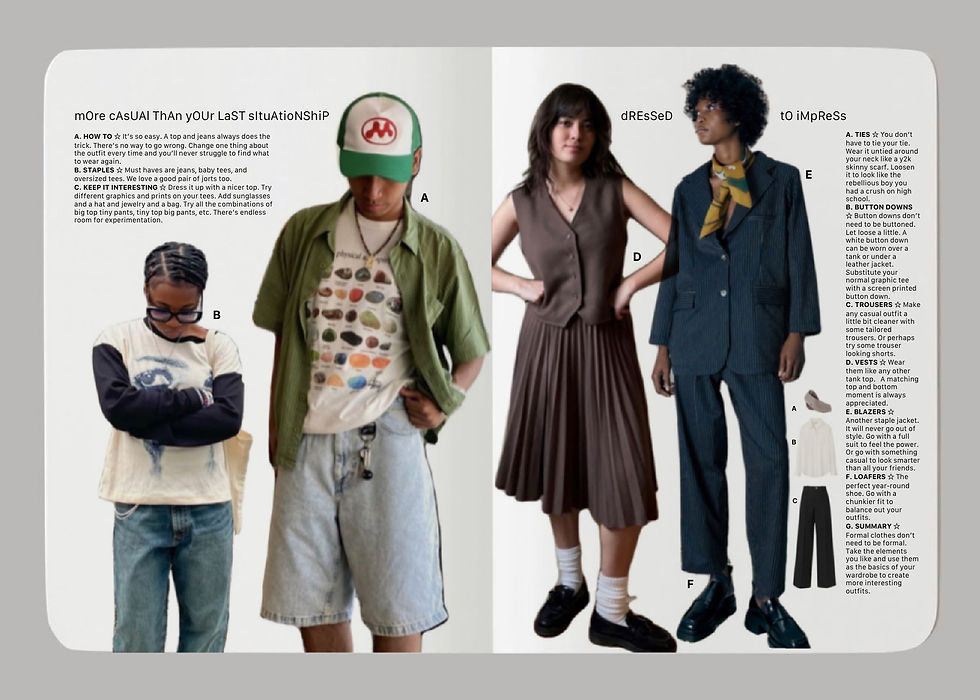
When I think of casual I think of California. The west coast in general is famous for its laid-back attitude, and living here I've definitely felt the effects of it. There's a sense of freedom that comes with being able to throw on a shirt and jeans, knowing that I can go on with my day with one less thing to worry about.
But there's also a sense of power that comes with dressing a little bit more formal. There's a reason why powersuits are a thing--they allow me to feel a boost of confidence that comes with knowing that I'm put together and polished. Something I like to do (and recommend to you) is to take one element of formalwear, like some tailored slacks or a vest, and pair it with the rest of my casual outfit. It gives me the same confidence boost while keeping me from sticking out like a sore thumb in more casual, everyday environments.
With that being said, here's moodboard #1:
2. DARK VS. BRIGHT
"Emo!" is one thing that many of my friends have joked about me. Whether its summer or winter, I wear only black everyday. Even though it's just a joke, being called an emo for simply wearing black tells a lot about how color influences how we are perceived. Black can be seen as sad, but it's also mysterious and elegant. And despite only being one shade, they absence of colors allows other aspects of your outfits, like the silhouette, textures, and layering, to take the spotlight.
Completely opposite to the absence of color, you have all the colors (yes, I know technically the opposite of black is white, but for moodboard purposes, this is more interesting). Dressing colorfully is embodied by the recent trend of dopamine dressing. Dopamine dressing is the idea that clothing choices can affect our mood and emotions, and that by intentionally selecting garments that evoke positive feelings, individuals experience a boost in confidence and well-being.
Enough talk! Here's moodboard #2:

3. FEMININE VS. MASCULINE
It’s important to recognize that the patriarchy and gender roles heavily inform this look. Through the patriarchy, masculinity is often portrayed as tough and brave through heavy fabrics and dark colors. Masculinity also sets the expectation to be dominant and in-control, conveyed through suits that imply richness and jobs that provide for the family while women stay at home, an expectation that stems from the cult of domesticity in the 19th century and before that. On the other hand, femininity is an image of submissiveness. Purity culture expects women to be modest, virgin, beautiful, obedient—like little girls, who have no agency or influence and simply things to be admired. In this way, femininity and masculinity are often portrayed as a false dichotomy.
Despite the harmfulness of these patriarchal expectations, we must also acknowledge the power of these stereotypes and expectations to validate our gender identities. The strict gender roles that masculinity and femininity embody give opportunity to subvert them, to transgress them. I say to take everything into account—the expectations and definitions of both femininity and masculinity—and reclaim it for yourself. Use it to your advantage. Break free of definitions. Men don’t have to be masculine, and women don’t have to be feminine. Portray yourself how you want to be portrayed. Mix masculinity and femininity together in a way that feels right to you.
With that being said, here’s moodboard #3 showing how femininity and masculinity presents itself in fashion:

INTROSPECTION
I know it's easier said than done, but stop caring what other people think. Tell the people-pleaser inside your head to shut up.
I'll be the first to admit that I haven't achieved this yet (or even come close to it), but I've come so far from where I was before, and I am so much happier. Sometimes I think back to my middle school days, when my insecurities controlled of everything I did wore (aka skinny jeans and graphic tees), and realize how unhappy I was. Style may be a way to transform how other people perceive us, but the most important thing is how it transforms how we feel about ourselves. How we feel in our skin. Style may be a powerful tool to transform how we feel, but in the end, it should only be a tool. Style shouldn't be everything; in the grand scheme of things, it's only a tiny aspect of our identity.
Here's a fancy metaphor for you, if you're into that kind of thing: style is like the shimmering surface of a lake, captivating and alluring, but it is the depth of the waters within that truly defines its essence. Just as the beauty of the lake lies not only in its reflection, but in the richness and life teeming beneath, so too should our focus be on cultivating the depths of our character. While style can be a powerful tool for self-expression and initial impressions, it is the authenticity, values, and virtues that reside within us that ultimately shape who we are and how we are perceived by others. Like the unseen currents that guide the lake's ecosystem, our inner qualities should be the guiding force that defines our true essence, while style serves as a mere reflection of the depths within.
Comments